
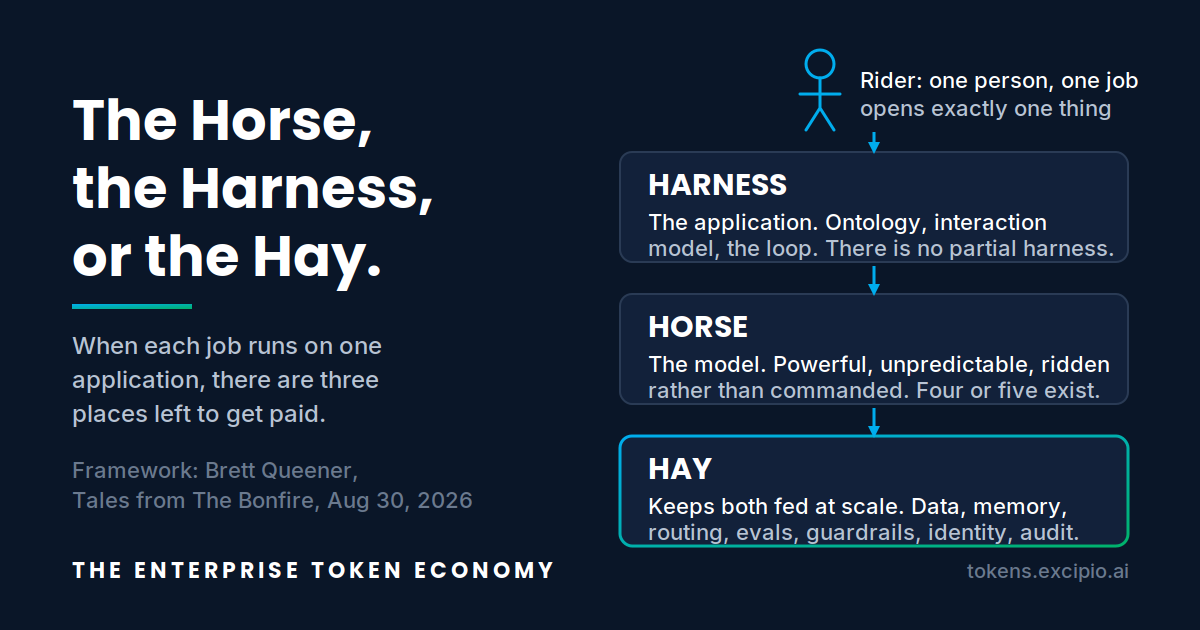
Brett Queener published a piece this week called The Harness, the Horse, or the Hay. It is a thoughtful look at the AI software cycle and an essential framework for making sense of where value settles. If you build, buy, or fund enterprise software, read it before you read this.
I won't summarize Brett's piece. Rather, I want to consider his ideas from the runtime side of the ledger… down in the inference traffic where memory and context actually live.
Brett's thesis in brief: because each worker will eventually collapse their workflow into a single interface, most legacy applications will disappear. What survives is the horse (the foundational model), the harness (the single application fitted to a rider and the complete job), and the hay (the operational infrastructure keeping horse and harness running at scale).
I mostly agree. But there is a crucial dynamic unfolding underneath his taxonomy:
The defining question of this cycle is not which category you belong to. It is who holds the loop.
The Claudeforce Problem
Brett defines the harness by four properties: it carries the ontology, it owns the interaction model, it owns the eval and learning loop, and it is singular.
Then, in his analysis of "Claudeforce," he does something far more interesting than categorize. He runs Salesforce against those four criteria for a sales rep and finds that it fails three of them. Salesforce kept the static records of system state. The corrections, the nuance, and the operational memory of how that seller actually works accumulated inside Claude.
His takeaway: the layer to watch is whoever ends up holding the loop.
That is the entire AI cycle in one sentence. Every enterprise AI deployment is answering a silent question: where does the accumulated judgment about how this company works actually live? Right now, by default, it is accumulating in whichever surface the employee used last. That is not an architectural strategy; it is entropy with a login.
Brett notes that no serious organization will surrender its embedded intelligence back to the frontier model providers, because a platform that serves your direct competitors cannot be the custodian of your DNA.
I would extend that rule one step further: no serious organization should hand that intelligence to a third-party harness either.
The harness vendor will argue the ontology belongs to them. For vertical micro-monopolies, that is true. But for the broader enterprise, the ontology is the company. Renting it back at renewal time is the SaaS trap rebuilt one layer higher.
The own-versus-rent decision is no longer about seats or licenses. It is about memory and context. If you rent the loop, you are a tenant in your own judgment.
Compounding Requires Singularity
The most compelling part of Brett's harness thesis is compounding: solve a job so thoroughly that the rider hands you everything, and within 60 days they ask you to run the adjacent workflow.
But compounding carries a precondition: corrections must land in a consistent place.
In reality, enterprise corrections land in fragmented silos. An account executive corrects a client fact inside a conversational assistant. A paralegal corrects contract logic inside a vertical workflow tool. A financial analyst catches a discrepancy in a sheet the harness never sees.
Each surface learns a fraction of the business, and none of them share the lesson. The loop is not closed; it is scattered. And a scattered loop does not compound… it leaks.
This makes the most critical word in Brett's thesis not harness, but singular. Singularity is what allows a feedback loop to close. If an employee operates out of a single surface, context compounds. Remove that singularity, and compounding halts regardless of ontology quality.
For the broad swath of the enterprise that will never find a single off-the-shelf vertical harness, that singularity cannot live at the application layer. It must come from the runtime layer shared across every surface.
Roadside Traces vs. Inline Control
In his evaluation of observability and evals, Brett drops a two-word aside: hold that thought. He later clarifies his rule: sell the instrument that produces judgment, never the judgment itself. Langfuse can show an engineering team where an agent pipeline stalled; it cannot tell them what institutional "good" looks like.
There is a technical distinction inside that layer that directly impacts value creation: observing a call and controlling a call are entirely different primitives.
A pure observability platform watches traffic after the fact and serves an execution trace. That is useful telemetry, but it is not a closed loop: a human reads a dashboard, files a ticket, and an engineer updates a prompt or code. Brett's own litmus test for a loop is whether a graded outcome alters future behavior without human intervention.
You cannot pass that test from the roadside. You can only pass it from inside the traffic.
If the layer evaluating the call also acts as the inline proxy routing it, the grade and the behavioral adaptation become the same runtime event. That is the dividing line between an instrument that merely records judgment and an instrument that executes it. Both belong in the hay category, but only one closes the loop.
What Hay Actually Pools
Brett applies a rigorous network-effect test to hay companies: serving 400 customers must make you structurally better than serving four, or you will be commoditized into a native feature. His examples include cross-model pricing, latency curves, failure signatures, and security heuristics.
Let's be explicit about what this layer should and should not pool:
What gets pooled: The physics of the traffic. Which models handle specific query shapes best, at what latency and cost. Where failure rates spike. Which routing strategies preserve uptime. No single customer can synthesize that alone, and frontier labs have no incentive to expose it because runtime transparency makes the customer portable.
What never gets pooled: The content. The semantic ontology. The enterprise's private context.
That data must remain strictly inside the customer's perimeter. Pooling proprietary content across tenants is the exact corporate self-harm Brett warns against.
Pool the physics of the traffic; never pool the meaning.
The Permanent Buyer
Brett frames "harness parts" as a transitional trap with two exits: step down into hay, or scale up into a harness.
The exit into hay is wider and more permanent than it looks. The self-assembling enterprise is not a transitional buyer waiting for a vendor to arrive. Regulated institutions will assemble their own stacks indefinitely, not because vertical SaaS failed them, but because governance, auditability, and legal liability mandate that they retain exclusive custody of their loop.
This is a durable market. These buyers do not buy proprietary harnesses; they buy primitives that integrate cleanly with their security posture.
The strategic question this leaves on the table is the one every CIO and technology leader should be asking:
Where does our loop live today, and who holds it?
If the answer is a sprawling list of disparate interfaces, you do not own it yet. If the answer is a single third-party application, you are renting it.
Horses will get faster, and harnesses will get bought. Through it all, the enterprise that retains custody of its own loop is the only party in the barn whose position compounds every year.