
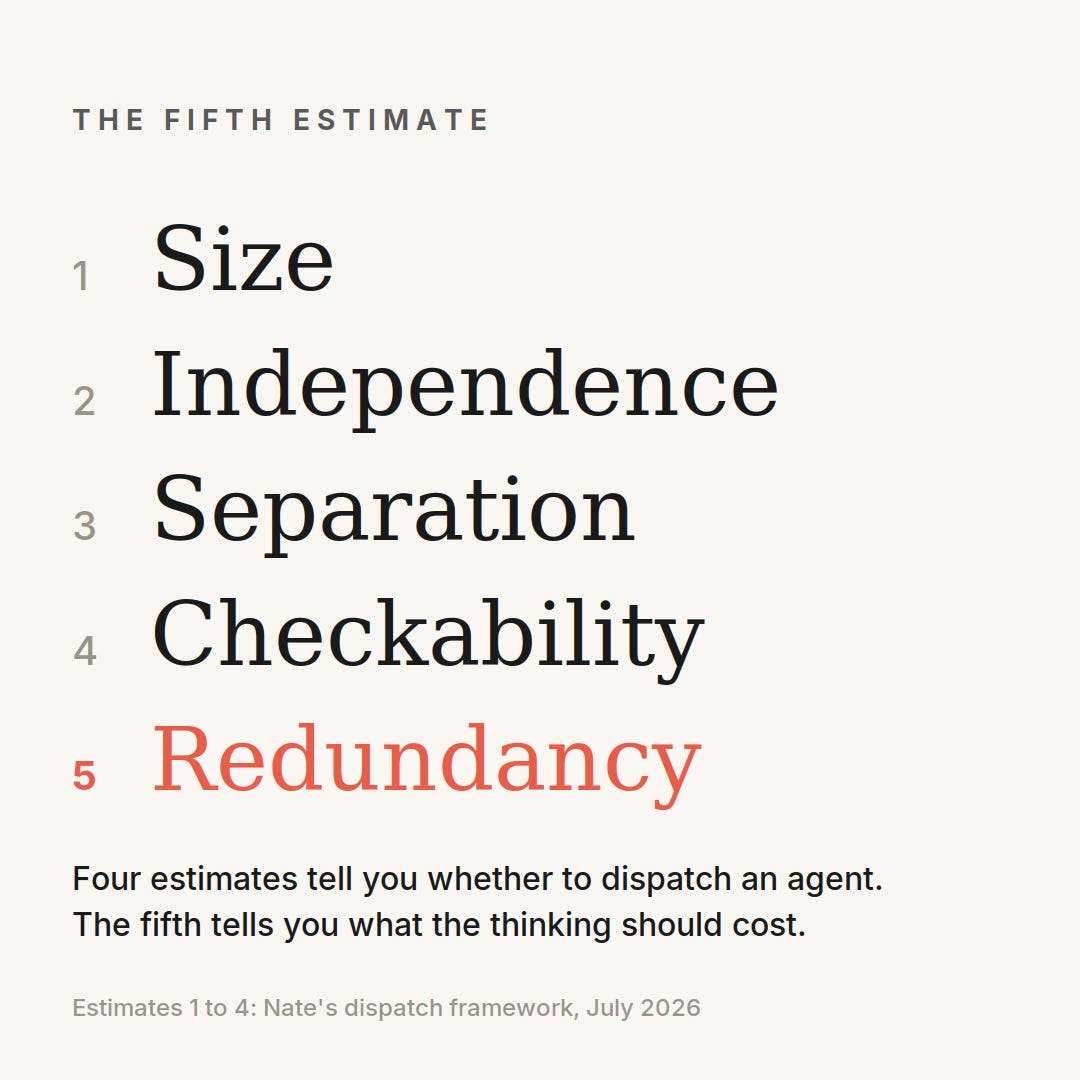
Nate published a dispatch rule this morning. Four things you can estimate about any task in about a minute: size, independence, separation, checkability. They resolve into one of four verdicts: a chat, one agent, a team, or don’t bother. Read it. It is the best budgeting frame I have seen for the question everyone with a freshly installed agent is quietly asking, which is “what do I even point this at?”
He opens with a number that should haunt every AI budget owner. More than 1.6 million agents signed up for an agents-only social network this year. Most were never asked to do a single thing. Not failed. Never dispatched. His diagnosis is right: nobody grew up with instincts for metered thinking. Thinking used to come attached to people. Now it is priced by the token and purchasable tonight.
So the dispatch question is a budgeting question. Agreed. But every budgeting rule has a price assumption buried inside it, and this one prices every token at retail.
The evidence that spend buys results
Two research results anchor Nate’s case, and both hold up at the source.
Stanford’s Scaling Intelligence Lab took DeepSeek-Coder-V2-Instruct, a model that solves 15.9 percent of SWE-bench Lite issues in one attempt, and let it try 250 times per problem. Solve rate: 56 percent. That beat the single-attempt state of the art from frontier models. The paper is called Large Language Monkeys, and its message is blunt. Coverage scales with samples across four orders of magnitude. Buying more attempts buys more answers.
Anthropic found the same thing from the other direction. In their analysis of their multi-agent research system, three factors explained 95 percent of performance variance on a hard browsing benchmark. Token usage alone explained 80 percent. Not prompt phrasing. Not orchestration cleverness. Tokens. Their multi-agent architecture beat a single agent by 90.2 percent on internal evals, and it did so by spending roughly 15 times the tokens of a chat interaction.
Both findings say the same thing: purchased thinking works. Spend more, get more. Which makes the dispatch decision exactly what Nate says it is, a question of whether the task justifies the spend.
Here is the assumption underneath: that every token in that spend was necessary.
The fifth estimate
Ask one more question about the task on your desk. Of the tokens this task will consume, how many purchase thinking your organization already owns?
Datadog measured what enterprise LLM traffic actually contains. 69 percent of input tokens are system prompts and repeated context, the same instructions and the same background re-transmitted call after call. Only 28 percent of caching-capable calls use caching at all. 72 percent of those workloads pay full frontier pricing to re-process identical context. And Gartner puts agentic AI at 5 to 30 times the tokens per task of a chatbot, which means every one of those redundancy ratios gets multiplied before it hits your invoice.
The architecture explains why. A transformer holds no memory between sessions and stores no records. When an agent seems to remember, the application is resending the entire transcript. Every new session gets a brilliant new consultant who has read everything and recalls nothing of the last meeting. So agents re-derive conclusions the organization validated last week, yesterday, or four seconds ago by the agent running next to them. I call this the Rediscovery Tax, and it is the single largest yield killer in agentic deployments.
Now look at Anthropic’s 15x multiplier again. Fifteen parallel context windows are fifteen consultants who cannot see each other’s notes. The very architecture that wins by spending tokens is the architecture where redundant spend compounds fastest. The 80 percent finding says token spend drives quality. It does not say wasted token spend drives quality. Those are different claims, and the gap between them is where your budget goes to die.
The metric is Token Yield: necessary spend divided by total spend. Every AI bill splits into unavoidable spend, the genuinely novel questions that legitimately require a frontier model, and recoverable waste, the tokens spent re-buying what you already know. No factory evaluates output per kilowatt. No logistics operator measures the fleet in gallons of diesel. Enterprise AI is the one budget line where we still confuse the meter with the metric.
Why this moves Nate’s verdicts
Run his four estimates on a task and suppose it lands on don’t bother. The economics fail: the task is agent-shaped, but the token bill exceeds the value of the output. That verdict was computed at retail, with every redundant re-derivation priced as if it were novel thinking.
Now compute it at yield. If a meaningful share of the task’s spend is recoverable waste, the effective cost of the necessary thinking is a fraction of the sticker price. Tasks migrate across the don’t-bother line. Not because the agents got smarter. Because you stopped paying full freight for thinking you already bought.
The same logic runs in reverse for the tasks you did dispatch. A team verdict at 15x tokens is only rational if those tokens are doing new work. If your agents spend most of their budget re-establishing context and re-validating each other’s conclusions, you did not buy a team. You bought one consultant fifteen times.
Nate’s rule tells you whether a task deserves purchased thinking. The fifth estimate tells you what that thinking should actually cost. Both questions take about a minute. Only one of them shows up on your invoice every month, forever, compounding with every agent you add.
The way out isn’t fewer tokens. It’s fewer wasted ones.
Sources: Nate’s dispatch guide, July 10, 2026. Brown et al., Large Language Monkeys: Scaling Inference Compute with Repeated Sampling, Stanford Scaling Intelligence Lab, arXiv 2407.21787. Anthropic, How we built our multi-agent research system, anthropic.com/engineering. Datadog State of LLM usage data and Gartner agentic consumption estimates as cited in The Enterprise Token Economy Issue 5.
Nate's Original Video Post: https://natesnewsletter.substack.com/p/agent-shaped-work?r=8363ez&utm_campaign=post-expanded-share&utm_medium=web