The Coordination Tax Is a Memory Problem
Ken Huang named the right tax. Here is where it lives, and how to stop paying it in 2026.

Ken Huang published an essay this morning that deserves a wide read. Writing in his Agentic AI newsletter, he argues that the binding constraint on AI adoption has shifted. Model labor is getting cheaper faster than organizational coordination is getting easier. Once agents run for hours, split work across parallel branches, and touch real workflows, the expensive part is no longer producing tokens. Rather, it is deciding who can act, what gets handed off, which artifacts matter, and when a human steps in. He calls this the coordination tax, and he is right that most teams are not measuring it.
Read his piece first. It stands on its own. What follows is an extension, because the coordination tax connects directly to the framework this newsletter has been building all year. Coordination is not a new tax. It is where the taxes we already track go to compound.
Fan-out multiplies redundant inference
Huang’s sharpest observation is that agent capacity now outruns human approval bandwidth. One operator can trigger ten parallel workstreams and generate more machine work in an afternoon than one person can casually supervise.
Here is what that fan-out does at the token layer. Parallel branches do not divide the work cleanly. They overlap. Each branch re-derives the same context, re-asks questions a sibling branch answered minutes ago, and re-buys conclusions the organization validated last week. The evidence for how much overlap already exists is stark:
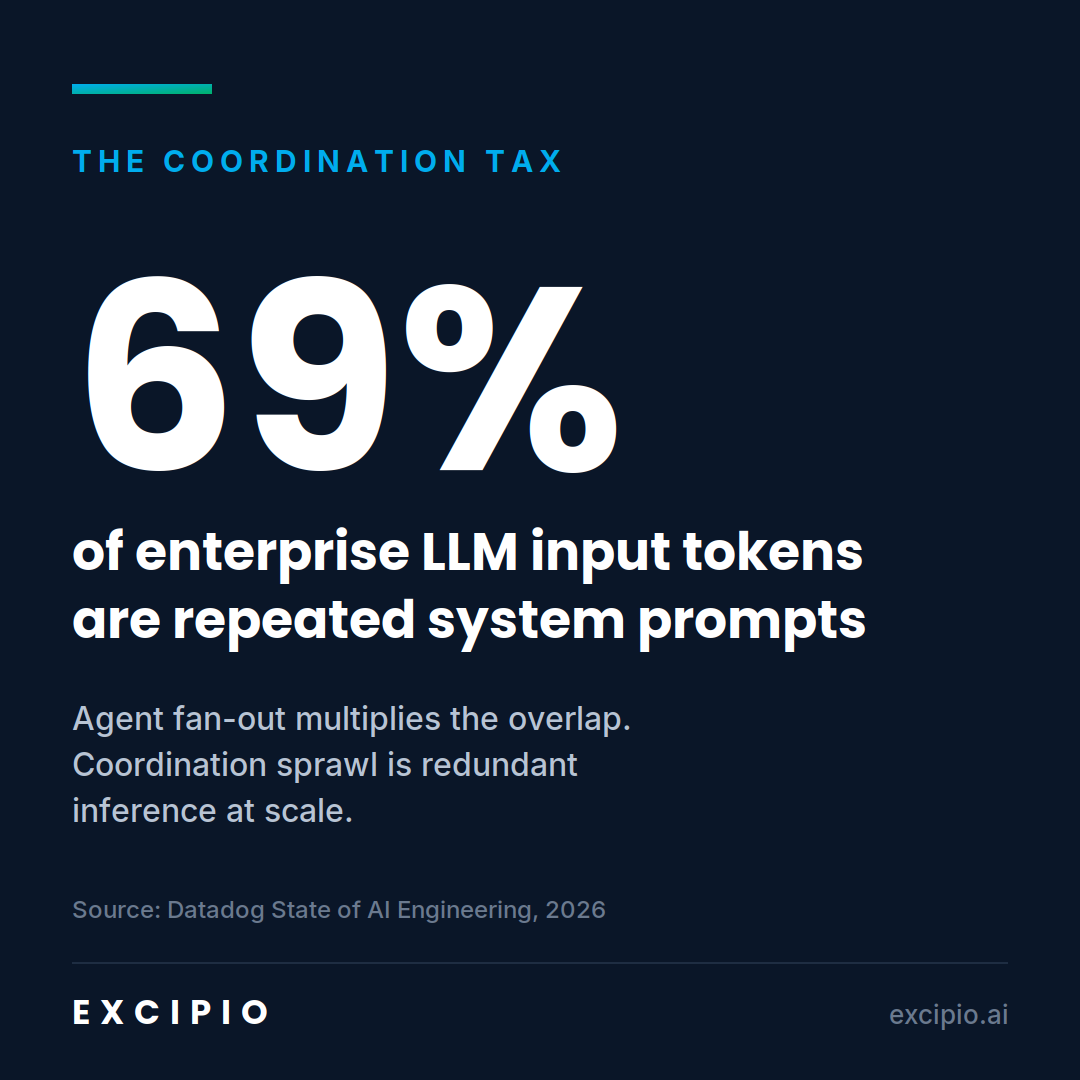
Datadog’s State of AI Engineering research found 69 percent of enterprise LLM input tokens are system prompts: instructions, policies, and tool guidance repeated verbatim across every call.
Only 28 percent of caching-capable calls in that research showed any cached reads. Most workloads pay full frontier pricing to re-process identical context.
Gartner estimates agentic AI consumes 5 to 30 times more tokens per task than chatbot workloads.
Stack those three findings and the conclusion is uncomfortable. The more agentic a workload becomes, the more of its spend is re-purchase rather than purchase. This newsletter calls that the Rediscovery Tax: the cost of re-processing answers the organization already owns. Fan-out does not just create Huang’s approval queue. It multiplies the Rediscovery Tax by the branch count.
Every handoff is a memory event
Huang argues the design unit of agentic systems is no longer the prompt. It is the handoff: what job is delegated, what authority transfers, what evidence must survive the transition.
Restate that as an infrastructure question and it answers itself. Evidence survives a transition only if it has somewhere durable to live. In most agent stacks today it does not. A transformer holds no memory between sessions and keeps no stored records. When a handoff drops context, that is not an etiquette failure between agents. It is the absence of a memory layer. The receiving agent reconstructs what the sending agent knew by re-deriving it from scratch, at frontier prices, with fresh opportunities for drift.
The artifact glut Huang describes has the same root. Drafts, traces, and half-finished outputs pile up because nothing in the system knows which answer is authoritative, where it came from, or whether it is still true. That is the Stale Answer Tax in operation: answers that were correct when generated persist after their underlying source has moved.
Review does not scale. Architecture does.
The instinctive fix is more governance: more review checkpoints, more approval gates, more humans reconstructing what happened. Huang’s own math shows why that fails. Approval bandwidth grows slowly and irregularly while agent capacity grows almost vertically. Governance that depends on a person reviewing outputs works exactly as well as that person, on the week they have time.
The durable fix is structural. Three properties, built into how AI knowledge gets stored:
Lineage: every answer knows the source it came from.
Invalidation: when that source changes, the answer expires automatically.
Source precedence: a standing rule for which source wins when two disagree, set before the conflict happens, not during it.
This is governance by architecture, not by contract. It compresses coordination the way Huang says the winners will: shorter approval paths because authority is explicit, fewer retries because context survives handoffs, less rework because artifacts carry their own validity.
How to evaluate a coordination-compression layer
For teams acting on this in 2026, four questions separate real memory infrastructure from another dashboard:
Ownership. Does validated knowledge accumulate in an asset you control, or inside a vendor’s model? Satya Nadella put this on the record at Davos in January 2026: a firm that cannot embed its knowledge in an asset it controls has no sovereignty. The sovereignty question is not where your data lives. It is where your intelligence compounds.
Lineage and invalidation. Can any answer show its source, and does it expire when the source changes? If governance lives in a review meeting instead of the storage layer, it will not survive fan-out.
Perimeter. When a known answer is served, does the query leave your network at all? Zero external transmission on a resolved query is a security property no audit trail can match.
Deployment cost. A memory layer that requires rearchitecting the agent stack recreates the coordination tax it claims to remove. The bar is a drop-in proxy: one BASE_URL change, live in hours.
This is the problem Excipio was built for: a private memory layer and semantic proxy network that intercepts agent queries and resolves known answers from a customer-owned, compounding knowledge graph before they reach a frontier API. Modeled results show roughly a 42 percent blended reduction in LLM API spend on Day 1, with resolved queries returning in 8ms against roughly 2,500ms for a live frontier call. The cost reduction is the mechanism. The mission is the asset: validated institutional intelligence that stays inside the perimeter and compounds permanently, instead of leaking into someone else’s model on every repeated question.
Huang ends his essay with a dividing-line question: is the workflow getting smarter, or just generating more work for the people around it? A workflow gets smarter in exactly one way. It remembers. The coordination tax is real, it is growing with every parallel branch, and it is, at bottom, a memory problem.
Read Ken Huang’s original essay, The Hidden Tax on AI Is Coordination, at his Agentic AI newsletter on Substack. It is worth your subscription.