The 80 Percent Price Cut Is a Margin Call on the Intangible Economy (2026)
Weights are non-rival. Serving is rival. And 92 percent of the S&P 500 just became a sorting question.

On July 30, OpenAI cut the price of GPT-5.6 Luna by 80 percent, three weeks after launching it. Input tokens dropped from $1 to $0.20 per million. Terra fell 20 percent. Sol held its price and gained a Fast mode that charges double for 2.5 times the speed.
Most of the commentary treats this as a pricing story. It is not. It is the first margin call on the intangible economy, and the collateral being marked down is every business model built on the assumption that intelligence would stay scarce.
What happened, minus the drama
A price cut this fast, this deep, on a model this new is not generosity. It is what pricing power looks like when it evaporates.
The pressure is documented. CNBC reported in July that Chinese models had captured 46 percent of US enterprise token usage on OpenRouter. DeepSeek V4 Pro was serving tokens at a fraction of Luna’s old price. Open weights had become a credible substitute, and once a credible substitute exists, the rent collapses.
That word, rent, is doing precise work. Understanding why requires one distinction that most of the coverage missed.
Weights are non-rival. Serving is rival.
Intelligence, once trained into a model, is a non-rival good. Copying the weights costs nothing. My use of them does not diminish yours. This is the same property that economics textbooks assign to lighthouse beams and national defense, and it has a known consequence: non-rival goods cannot sustain a price above the cost of delivering them once a substitute exists.
Serving is different. Running a model consumes GPU seconds, power, and memory bandwidth, all of which are consumed exclusively. Serving is rival, and it has a real cost floor.
So what deflated on July 30 was not the cost of intelligence. It was the rent being charged on top of a non-rival good. The 80 percent cut is not a strategy. It is arithmetic catching up with structure. You cannot hold a rent on something anyone can copy once someone with a cluster decides to serve the copy at cost.
This makes the deflation predictable rather than shocking. Nobody needed to see the future. They needed to read the asset class.
The rhyme: dark fiber and free browsers
We have run this experiment before.
In the late 1990s, telecom carriers overbuilt fiber on the assumption that bandwidth scarcity would persist. It did not. Global Crossing and WorldCom collapsed. The fiber went dark for a decade. And the companies that won the internet were the ones that designed as if bandwidth were free before it was. Streaming video looked insane in 2002 and inevitable in 2012. The only thing that changed in between was who ate the deflation.
The modern dark fiber is depreciated accelerators. As frontier training moves to next-generation silicon, the prior generation does not disappear. It becomes the commodity inference substrate, serving open weights at something close to cost. That glut is already forming, and the OpenRouter numbers are its first visible symptom.
The browser tells the second half of the story. Netscape tried to monetize the artifact. Microsoft gave it away. The browser’s value did not evaporate. It relocated, from the thing itself to the position it occupied. Value moved to what ran inside the browser and to whoever controlled the default.
Transport commoditized. The layers above it captured the value. That is the rhyme.
Where the rhyme breaks
Analogies earn trust by admitting their limits. This one has two.
First, bandwidth had no permanent frontier tier. A gigabit in 2010 was a gigabit. Model capability keeps moving, so there is always an expensive tier that has not commoditized yet. Sol held its price while Luna fell 80 percent, and that split may be structural rather than transitional. The frontier stays priced. Everything a year behind it deflates to the marginal cost of serving.
Second, the telcos did not own the layer above them. Global Crossing had no cloud business. The AI labs and hyperscalers are vertically integrated across compute, weights, and application. Value migrating up the stack does not automatically mean value migrating away from incumbents this time. They are waiting at the top of the stack too.
Both caveats sharpen the question rather than dulling it. If the commodity layer deflates and the incumbents contest the layers above, the only durable position is one they cannot copy or subpoena. Which brings us to the number that reframes the whole event.
The 92 percent problem
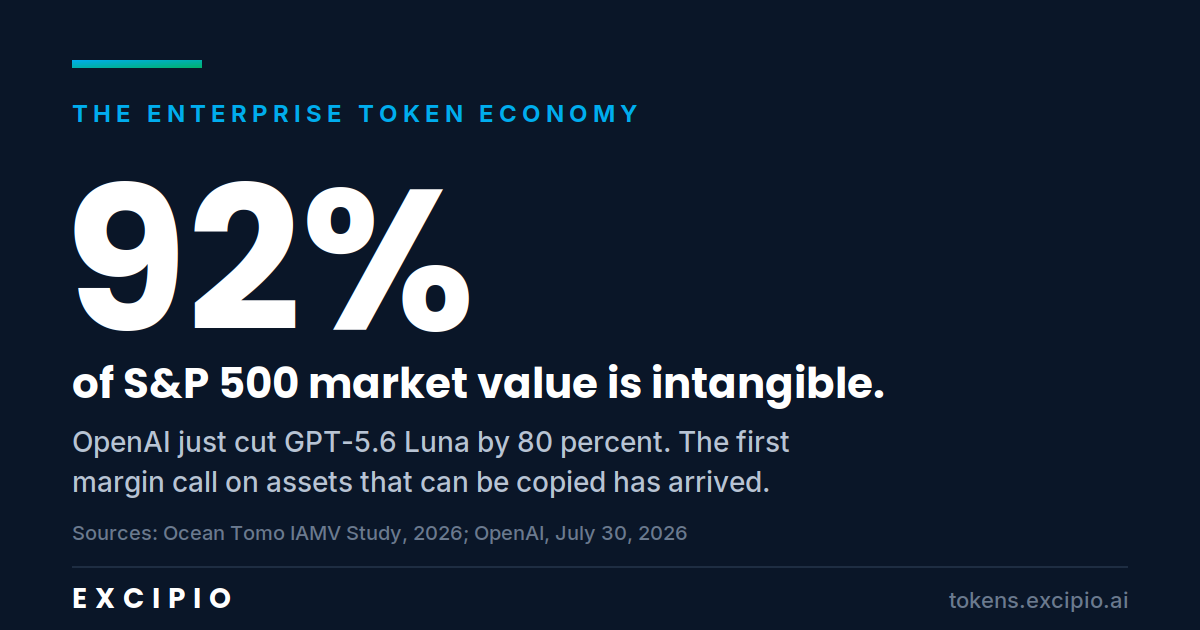
Ocean Tomo’s 2025 Intangible Asset Market Value Study, released in February 2026, puts intangible assets at roughly 92 percent of S&P 500 market capitalization, up from 17 percent in 1975. Fifty years of American enterprise migrating its value out of things you can touch and into things you can think.
Then along comes a technology whose entire function is to copy, compress, and regenerate thought at near zero marginal cost.
That is why July 30 matters beyond model pricing. It is a preview of what happens to any intangible asset that turns out to be non-rival and non-excludable. Ninety-two cents of every S&P 500 dollar is now exposed to a sorting question, and the sorting runs on one axis: excludability. Sort the intangible dollar into three buckets.
Codified knowledge. Anything that can be written down: documentation, methodologies, playbooks, generic software patterns. Non-rival by nature and increasingly non-excludable in practice. This is the bucket the models ate first, and the Luna cut just repriced it toward zero.
Legally excludable IP. Patents, trademarks, copyrights, trade secrets. Here rivalry is manufactured by law. The asset holds value only as long as the legal regime holds.
Structurally excludable assets. Proprietary data, accumulated and validated context, distribution, regulatory position, switching costs. Excludable by architecture rather than statute. Nobody can copy their way into these, and nobody can litigate their way in either.
Bucket one just got marked to market. Bucket three is where value is fleeing. Bucket two is the interesting one, because its floor is about to be tested.
The other shoe: IP, know-how, and licensing
The legal regime that makes bucket two excludable was written for an economy where copying was hard and generation was human. Every pillar of it is under live stress at once.
Training inputs sit in unresolved copyright litigation, with fair use doctrine stretched over a use case it was never shaped for. Model outputs receive no copyright in most jurisdictions, which produces a perverse result worth sitting with: the more your product is model-generated, the thinner your own IP claim on it becomes. The data licensing market is being priced in real time, with publishers and platforms negotiating rents on assets whose enforceability the courts have not yet confirmed.
And then there is know-how. Trade secret protection depends on information deriving value from secrecy and receiving reasonable efforts to keep it secret. General counsels are beginning to ask an uncomfortable question: what happens to that claim when the substance of your know-how is transmitted to a third-party inference endpoint on every API call? I am not offering a legal conclusion. I am observing that the question is now on the table at every regulated enterprise, and that it is an architecture question wearing a legal costume.
The common thread: legal excludability is itself a kind of rent, and it can be repriced by a ruling as abruptly as Luna was repriced by a press release. Structural excludability cannot. Its defensibility never depended on a judge.
Where B2C and B2B actually split
The obvious prediction is that consumer AI goes cheap and DIY while enterprise stays frontier. The evidence runs the other way. The largest consumer deployments on earth run open weights, because billions of users against thin revenue per user cannot pay frontier rates. Meanwhile an enterprise vendor charging $500 per seat can burn a few dollars of tokens per seat and never notice.
So the split is not B2C versus B2B. Two different variables are doing the sorting.
Consumer sorts on unit economics: revenue per inference call against the cost of that call. The Luna cut resolves most of that question by making frontier access cheap enough that DIY loses its main argument at consumer scale.
Enterprise sorts on sovereignty. Regulated buyers carry contractual, statutory, and privilege-based constraints on where their information may travel, and those constraints do not read pricing tables. Satya Nadella named this at Davos in January 2026: a firm that cannot embed its knowledge in an asset it controls has no sovereignty and is leaking enterprise value to a model company on every query. An 80 percent price cut changes the size of the leak’s invoice. It does not close the leak.
There is a second reason the cut will not shrink enterprise AI budgets: volume. Datadog’s 2026 State of AI Engineering report, drawn from thousands of organizations, found that 69 percent of enterprise LLM input tokens are system prompts and repeated context. Agentic workloads multiply calls faster than prices fall, and the repeated context rides along on every one of them. Cheaper tokens do not reduce the habit of re-buying answers you already own. They subsidize it. Jevons had this figured out in 1865 with coal.
How to sort your own intangibles
If you run a SaaS company, an AI product, or a P&L that depends on either, the exercise is uncomfortable but short. Take your differentiation claims and ask three questions of each.
First, can it be copied? If a competitor with API access and a quarter can replicate it, it is bucket one. Stop calling it a moat in board meetings before someone does it for you.
Second, does its defensibility depend on a legal outcome you do not control? Then it is bucket two, and it deserves a discount rate that reflects doctrinal uncertainty, not the discount rate you were using in 2023.
Third, does it compound in an asset you own? Validated answers, corrected outputs, accumulated context, customer-specific knowledge that gets richer with use. That is bucket three. It is the only bucket where AI spend builds equity instead of paying rent, and it is the only story worth telling an investor in 2026.
I spent part of my career pricing intangible value in public markets, running a fund that traded US large-cap equities on proprietary brand signals. The lesson from that work holds here. The market has never doubted that intangibles carry the value. The question, every time, is which intangibles stay defensible when the copying gets easier. On July 30, the copying got 80 percent cheaper.
Rent the commodity. Own the differentiation. The price of the commodity just told you which is which
.